Author: admin

  • Crypto Advertising in 2026: Meta’s Three-Tier Authorization Explained

    Crypto Advertising in 2026: Meta’s Three-Tier Authorization Explained

    Crypto Advertising in 2026: Meta’s Three-Tier Authorization Explained | Nucleus
    Meta Ads 2026 Three-Tier Authorization Global Compliance

    Crypto Advertising in 2026: Meta’s Three-Tier Authorization Explained

    If you run a crypto exchange, a wallet product, or a token project and you have tried to run a Meta ad campaign recently, you may have already hit this wall: your ad gets auto-rejected within seconds, with no clear explanation beyond a generic policy citation. If that has happened to you since March 2026, there is a specific reason, and it is a structural one.

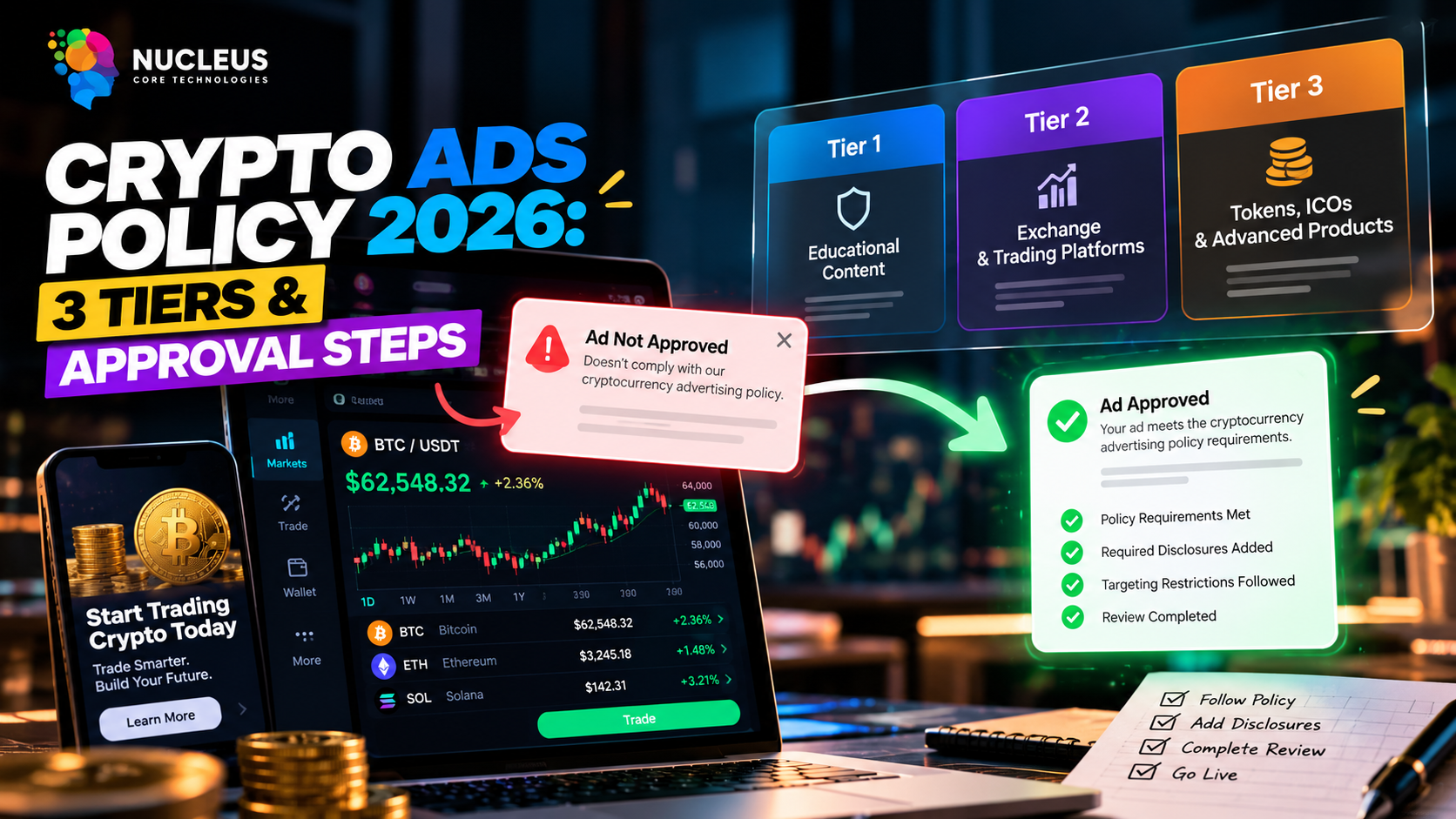
    Meta overhauled how it handles crypto advertising, replacing its old single-gate authorization system with a three-tier model that treats different kinds of crypto businesses very differently.

    Most of what has been published about this change so far is thin: a paragraph here, a bullet list there, often contradicting other sources on the details. This guide pulls it together properly, explains what each tier actually means, walks through the application process, and covers what this looks like specifically if you are advertising from or into India, Europe, or the United States, since the regulatory backdrop differs meaningfully across those three regions even though Meta’s tier structure itself is global.

    1. What Changed, and Why

    Before March 2026, Meta ran crypto advertising through a single authorization gate: you applied for written permission, demonstrated some form of regulatory legitimacy, and if approved, you could generally run most types of crypto ads. It was a blunt, binary system – authorized or not.

    That system did not scale well with how varied the crypto industry actually is. A fully licensed exchange regulated by a major financial authority and a brand-new, unlicensed DeFi protocol were, from Meta’s enforcement perspective, sitting in roughly the same bucket. Meta’s March 2026 update replaced that single gate with three distinct tiers, each with different eligibility requirements, different allowed campaign types, and different creative restrictions. The goal, broadly, is to let heavily regulated, licensed businesses operate with more freedom while keeping tighter restrictions, or outright exclusion, on less regulated or unverified crypto activity.

    Global Expansion Note: This sits alongside a broader tightening of financial advertiser verification on Meta generally. Mandatory financial advertiser verification now applies in a much larger set of countries than it used to, up from roughly a dozen countries in 2024 to several dozen worldwide today. This means more crypto advertisers are being pulled into identity and business verification requirements even before they get to the crypto-specific tier system.

    2. The Three Tiers, Explained

    Here is where a lot of existing content gets vague or inconsistent, partly because Meta’s own public language on this is still sparse, and partly because the tier definitions involve some judgment calls on Meta’s part. Based on the clearest available reporting, here is how the three tiers generally break down.

    Tier 1

    Verified & Regulated

    FCA, SEC, MAS, BaFin licensed entities. Maximum ad format access.

    Badge Granted
    Tier 2

    Partially Regulated

    Non-custodial, DeFi, NFT markets with verified volume. Restricted formats.

    Strict Scrutiny
    Tier 3

    Unverified / Locked

    Unlicensed tokens or purely educational without product promotion.

    Auto-Rejection

    Tier 1: Regulated exchanges and custodians

    This is the top tier, reserved for businesses that hold active licenses from recognized financial regulators, bodies like the FCA in the UK, the SEC in the US, MAS in Singapore, or BaFin in Germany. Tier 1 advertisers are the ones Meta trusts the most, and they are rewarded with the widest range of allowed campaign types: awareness, app download, and conversion campaigns are generally available, rather than being restricted to a narrow set of formats. Tier 1 advertisers also receive a “Verified Crypto Advertiser” badge, which effectively acts as the credential that unlocks crypto ad eligibility across the account.

    If you are a licensed, regulated exchange or custodian, Tier 1 is where you want to land, and it is worth noting that this tier explicitly excludes certain product types even for licensed businesses. Yield claims and promotional language implying guaranteed returns are restricted regardless of your tier, and disclaimer requirements apply even to fully licensed, Tier 1 advertisers.

    Tier 2: Licensed or partially regulated products

    Tier 2 sits in a genuinely ambiguous middle ground, and this is where the existing coverage online disagrees most. Some descriptions frame Tier 2 as “licensed non-custodial” products specifically. Others describe it more broadly as covering emerging or partially regulated categories, including some DeFi services, NFT marketplaces with verifiable transaction activity, and crypto lending products operating in regions where they have some form of regulatory standing, even if it is not full licensure in the way Tier 1 requires.

    What seems consistent across sources is that Tier 2 advertisers face real limitations: a narrower set of allowed campaign types than Tier 1, additional creative restrictions, and stricter review of claims. For example, NFT marketplace advertisers that can demonstrate verifiable transaction volume may be eligible for Tier 2, but any creative emphasizing investment potential or price appreciation gets rejected outright, regardless of tier.

    If your business does not hold a full regulatory license but operates with some legitimate compliance standing, this is likely where you land, and it is worth treating Tier 2 as a tier to actively work your way up from rather than a stable resting place, since the requirements and restrictions here are the most likely to keep shifting as Meta refines the system.

    Tier 3: Unverified or educational-only

    Tier 3 is effectively the bottom of the system, and here too there is some inconsistency in how it is described. Some sources frame Tier 3 as strictly educational content, crypto and blockchain news, explainer content, and industry commentary that does not promote a specific financial product or service. Other sources describe Tier 3 as simply “unverified,” with the practical outcome being that all crypto-related ads are automatically rejected.

    In practice, these two descriptions are not necessarily in conflict: if you have not gone through authorization at all, your ads get auto-rejected regardless of content, including educational content that references specific products or token names. True educational content about blockchain technology in general, without promoting a specific trading product, has historically been treated by Meta as not requiring authorization in the first place, separate from this tier system entirely. The tier system itself is really about advertisers trying to promote an actual crypto product or service, and if you cannot clear at least baseline verification, you are functionally locked out.

    3. Universal Rules, Blanket Bans, and Existing Accounts

    Before even getting into tiers, it helps to know what triggers Meta’s crypto policy at all. Meta’s rule is broad: prior written permission is required for any product or service that enables monetization, reselling, swapping, or staking of cryptocurrency. This explicitly covers exchanges and trading platforms, crypto lending and borrowing products, wallets that let users buy, sell, swap, or stake assets (not just store them), and crypto mining hardware and software.

    On the other side, a few categories do not require this authorization at all: genuine educational content, industry news and events coverage, and wallets that purely store crypto without any buy, sell, swap, or stake functionality. If your product is a pure storage wallet with no trading functionality built in, you may not need to go through this process at all, which is worth confirming before you assume you need Tier 1 or 2 authorization.

    Blanket Exclusions

    Two categories are flatly excluded regardless of tier or licensing: memecoin advertising is prohibited outright, and DeFi yield or liquidity protocol ads are rejected categorically, independent of how the product is described or what disclaimers are attached. No amount of Tier 1 licensing changes this; these are blanket exclusions.

    What Happened If You Were Already Authorized

    If your business held crypto ad authorization from Meta before March 2026 under the old single-gate system, you were not left out in the cold. Meta automatically migrated existing authorized advertisers into a provisional tier classification rather than requiring everyone to reapply from zero.

    That said, “provisional” is the operative word. If your provisional placement does not match what your actual licensing supports, you may find yourself facing tighter restrictions than you expect, or getting flagged in a later review cycle even though your ads were running fine for months beforehand. It is worth proactively checking your current tier status in Meta Business Suite rather than assuming your pre-2026 approval still fully applies.

    4. Practical Application Blueprint (How to Apply)

    Transitioning into the new framework requires methodical execution. Below is the precise 7-step checklist you must follow within your Facebook Business Manager to secure authorization.

    Meta Authorization Checklist

    0/7 Done

    5. Regional Comparison: India, Europe, and the US

    Meta’s tier system is global, but what counts as “regulated” or “licensed” varies significantly by region, and each of these three markets has its own layer of complexity on top of Meta’s rules.

    United States

    US-based crypto advertisers generally need to point to recognized federal or state-level regulatory status. SEC oversight, alongside state-level licenses like a BitLicense in New York, are primary indicators.

    US crypto regulation is still evolving and fragmented across federal and state lines. If you are a US exchange or custodian with clear federal or state licensing, Tier 1 is realistic. If you are an early-stage token project or DeFi-adjacent product without that licensing, expect Tier 2 at best.

    Europe

    European advertisers benefit from a relatively clearer regulatory reference point. Licenses from authorities like BaFin in Germany or similar MiCA-aligned regulators across the EU are explicitly cited as qualifying credentials for higher-tier status.

    The EU’s MiCA framework has been pushing crypto businesses toward formal licensing more systematically than the US has managed so far, which in practice makes it straightforward for a properly licensed EU exchange to document Tier 1 eligibility.

    India

    India is the market where this gets most complicated. Cryptocurrency is not recognized as legal tender in India, and there is no equivalent to an FCA, SEC, or BaFin-style crypto-specific regulator that Meta’s Tier 1 criteria are built around.

    What India does have is the Advertising Standards Council of India (ASCI) guidelines for virtual digital asset (VDA) advertising. These require every crypto ad to carry a specific disclaimer stating that crypto products are unregulated and risky. ASCI rules prohibit using words like “currency”, “securities”, “custodian”, or “depositories” in crypto advertising.

    This creates a layered compliance situation for Indian crypto advertisers on Meta: you still need to clear Meta’s tier system (likely Tier 2), and separately, your ad creative needs to comply with ASCI’s disclaimer and language rules regardless of which Meta tier you are authorized under. (A large majority of flagged crypto ad violations in India come from influencer content, which is vital to monitor).

    6. Common Mistakes Across All Markets & The Moving Target

    Avoid These Critical Errors

    • Assuming grandfathered authorizations still fully apply. Check your actual current tier status rather than assuming nothing changed.
    • Applying for Tier 1 without official regulatory documents. Submitting an application that claims full regulatory licensing without the actual license on file just delays approval.
    • Treating Meta authorization as local legal compliance. Particularly relevant for Indian advertisers (the ASCI trap). Both need to be satisfied independently.
    • Using yield, passive income, or guaranteed-return phrasing. This is one of the most consistent rejection triggers across all three tiers.
    • Blending educational copy with product-level CTAs. If your content mixes general crypto education with specific product calls-to-action, it is likely to be reviewed as promotional content requiring full authorization.

    A Moving Target

    If there is one honest caveat to end on, it is this: Meta’s own public documentation on the specific tier boundaries is still thinner than the volume of secondary coverage might suggest. This is a genuinely new system still being refined, which means the practical edges are likely to keep shifting over the next few policy cycles.

    If you are planning a campaign with real budget behind it, it is worth verifying your specific tier status and documentation requirements directly in Meta Business Suite before committing spend.

    Getting This Right the First Time

    Crypto advertising compliance now sits across at least two to three complex layers. Getting your tier classification wrong triggers account-level scrutiny that impacts your entire media infrastructure.

  • How to Get Certified to Run Gambling Ads on Google and Meta

    How to Get Certified to Run Gambling Ads on Google and Meta

    How to Get Certified to Run Gambling Ads on Google and Meta | Nucleus
    Meta Ads Google Ads iGaming Compliance

    How to Get Certified to Run Gambling Ads on Google and Meta (Country-by-Country Guide)

    If you are planning to launch a betting or gaming product and you have started researching how to advertise it, you have probably already discovered the uncomfortable truth: neither Google nor Meta makes this easy to figure out. There is no single “apply here” button, no unified checklist, and the rules differ not just between platforms but between every country you want to target. Documentation is scattered across help centers, support forms, and policy pages that get updated multiple times a year without much notice.

    This guide pulls that process together in one place. We will walk through how certification actually works on Google Ads, how authorization works on Meta, what you need to prepare before you apply, and how to think about sequencing your country rollout so you are not stuck waiting on fifteen separate approvals before you can launch anywhere.

    One caveat before we start:

    Both platforms update their restricted-country lists and application requirements frequently, sometimes multiple times a year. Treat this guide as a framework for understanding the process, not a substitute for checking the live policy pages before you submit anything. We will point you to where to verify current requirements at each step.

    Platform Certification Architecture

    Google Ads Path

    1. Market Check

    Verify inclusion on live eligible lists.

    2. License Mapping

    Match entity docs to target country.

    3. Policy Health Audit

    Clear prior violations before submitting.

    4. Formal Certification

    Awaiting manual Google policy review.

    Meta Authorization

    1. Meta Restrict List

    Cross-reference independent Meta lists.

    2. Business Suite Setup

    Define operator vs. affiliate status.

    3. Age Floor Lock

    Enforce global 18+ strict targeting.

    4. Territory Request

    Submit written proof for specific regions.

    The Core Principle: Certification Is Per-Country, Not Global

    The single most important thing to understand before you start is that gambling advertising approval is never a one-time, global event on either platform. You do not get “certified for gambling” the way you might verify a business once and be done with it. Instead, certification is tied to specific countries, specific licenses, and in some cases specific websites or domains.

    This means an operator with a license in the UK and a separate license in Spain has to go through the certification process separately for each country, even on the same platform, even using the same ad account. If you are planning a multi-market launch, this has real implications for your timeline: you cannot treat certification as a single pre-launch task. It is a per-market workstream that needs to be scheduled market by market.

    It also means that a certification you hold for one country gives you no coverage in another, even a neighboring one with similar gambling laws. A license and approval covering Germany does not unlock the Netherlands, France, or any other market, however similar the regulatory environment might look on paper.

    Meta Gambling Ad Authorization: The Process

    Meta’s process is structured differently from Google’s, though the underlying principle – country-specific, license-backed approval – is the same.

    Step 1: Confirm the country is not on Meta’s unsupported markets list

    Like Google, Meta maintains its own list of countries where gambling advertising is not permitted at all, regardless of your licensing status. This list is not identical to Google’s, so clearing Google’s country check does not mean you have cleared Meta’s. Check Meta’s current restricted markets for gambling and gaming directly before applying.

    Step 2: Submit your authorization request through Meta Business Suite

    Since mid-2025, Meta centralized this process into the “Authorizations and Verifications” tab inside Meta Business Suite, replacing what used to be a manual, email-based written-permission process. You will need to specify your Business Manager ID, the specific country or countries you are requesting, and documentation proving your gambling activity is properly licensed or otherwise legally established in each territory.

    You will also need to declare your role, whether you are the operator, an aggregator, or an affiliate, since each of these categories is treated slightly differently in Meta’s review.

    Step 3: Wait for review, and plan around the real timeline

    Meta’s gambling authorization process typically takes several weeks, and applications covering more countries or more complex licensing structures can take longer. This is meaningfully slower than most standard Meta ad account reviews, and it catches a lot of first-time applicants off guard when they assume Meta approvals move at the same speed as a normal ad.

    Step 4: Respect the age and targeting requirements

    Across every approved market, Meta requires that gambling ads never target anyone under 18, regardless of the local legal gambling age if it happens to be lower. This is a platform-wide floor, not a country-specific variable.

    Step 5: Handle affiliates and influencers separately

    If your gambling marketing involves affiliates or influencers, know that Meta treats them as requiring their own authorization in most cases. An affiliate promoting a licensed operator generally needs to register and be approved separately, even though they are promoting an already-authorized brand. The one common exception is when the licensed operator itself creates the ad and simply tags an influencer or creator in it; in that specific setup, the tagged creator typically does not need separate authorization. But if the affiliate or influencer is creating and running their own ad account’s campaign, they need their own approval. This is one of the most commonly missed requirements, and it is a frequent cause of affiliate campaigns getting shut down even when the core operator relationship is fully compliant.

    Step 6: Know that authorization is not permanent

    Similar to Google, Meta’s authorization is not a one-and-done status. It is tied to your continued license validity in each territory, and significant changes – like a new country, a new licensed entity, or a change in your business structure – generally require submitting an update or an “add territory” request rather than assuming your existing approval automatically extends.

    Country-by-Country: How to Actually Approach This

    Because the specific list of approved countries, license requirements, and application nuances shift throughout the year on both platforms, we are deliberately not printing a static table of “approved countries” here; any such list risks being outdated within months, and running a gambling campaign off a stale list is exactly how accounts end up suspended. Instead, here is the research process we would recommend for any new market:

    1. Check both platforms’ current approved/restricted country lists independently. Do not assume overlap. A market open on Google may be closed on Meta, or vice versa.
    2. Confirm your license is accepted for that exact country, issued by the specific regulator that country’s advertising policy recognizes, not a license from a different but related jurisdiction.
    3. Check for sub-national rules. Some countries, the US being the clearest example, regulate gambling advertising at the state level, not nationally. A federal-level green light does not mean every state is open, and both platforms require this to be handled state by state in markets structured this way.
    4. Build your rollout sequence around the slowest approval, not the fastest. If you are planning a five-country launch, your public launch date should be set by your longest expected certification timeline, not your shortest. Launching in three approved markets while two are still pending is almost always a better plan than delaying everything until all five clear.
    5. Revisit your country list regularly, not just at launch. Both platforms have changed market eligibility multiple times within 2026 alone. A country that was closed when you last checked may have opened, or vice versa.

    Common Mistakes That Delay Certification

    A few patterns show up again and again with operators going through this for the first time:

    • Applying before confirming the country is actually open. This wastes review time on an application that was never going to be approved, because the market itself is not eligible, independent of your licensing.
    • Mismatched business entities. Your licensed gambling entity, your ad account’s registered business, and your domain ownership all need to clearly connect. Any mismatch between these – say, a license held by a parent company while the domain is registered to a different subsidiary – is a frequent source of delay.
    • Treating certification as a marketing task instead of a compliance task. The actual application and documentation work is closer to a legal/compliance function than a media-buying one. Operators who loop in compliance or legal from the start generally move faster than those who have their marketing team try to assemble licensing proof on their own.
    • Assuming approval is permanent. Letting a license lapse, changing your corporate structure, or accumulating policy violations elsewhere in the account can all put existing certification at risk. This needs to be monitored on an ongoing basis, not just secured once.
    • Underestimating affiliate and influencer obligations on Meta specifically. Many operators correctly certify their own operator account, then get blindsided when their affiliate network’s ads get pulled because the affiliates never went through their own authorization.

    Planning Your Launch Timeline Around This Reality

    Given that certification can take anywhere from roughly one to several weeks per country, and that it needs to happen separately for every market, the practical implication for a betting or gaming operator planning a launch is this: certification needs to start well before your intended go-live date, and it needs to be sequenced deliberately.

    A reasonable approach looks like this: identify your priority launch markets early, start certification applications for your two or three highest-priority countries immediately, and treat any additional markets as a second wave that begins once the first batch is in motion, not after it is complete. Trying to certify ten markets simultaneously as a first-time applicant usually just means ten slow-moving applications instead of a few fast ones.

    When to Bring in Specialist Help

    Gambling ad certification sits at the intersection of marketing, legal compliance, and platform policy, and it changes often enough that even teams who have done it before need to re-verify requirements on every new launch. If you are planning a multi-market rollout, or if you are new to this process and trying to hit a specific launch date, working with an agency that manages certification applications regularly can save weeks of back-and-forth, particularly around the documentation and entity-matching issues that cause most delays.

    If you are not sure where to start, the fastest useful first step is usually a market-by-market audit: confirming exactly which of your target countries are currently open on each platform, what licensing you already have versus what you would need, and a realistic sequencing plan based on that. That one piece of groundwork tends to prevent most of the downstream delays described above.

    Stop Guessing with Platform Compliance

    Need to sequence your multi-market iGaming launch without triggering algorithmic suspensions? Let our compliance and ad specialists handle the heavy lifting.

  • Why Was My Crypto or Gambling Ad Rejected on Google or Meta? Common Reasons and Fixes

    Why Was My Crypto or Gambling Ad Rejected on Google or Meta? Common Reasons and Fixes

    Why Was My Crypto or Gambling Ad Rejected? | Nucleus
    Google Ads Meta Ads Restricted Niches

    Why Was My Crypto or Gambling Ad Rejected on Google or Meta? Common Reasons and Fixes

    7 Min Read

    If you are reading this right after getting a rejection notice, here is the short version: you are not alone, it is probably fixable, and panicking will slow you down more than it helps. Crypto and gambling are two of the most heavily policed advertising categories on both Google and Meta.

    Both platforms reject a huge share of first-time submissions in these niches, even from legitimate, licensed businesses. This is not a sign you did something uniquely wrong. It is a sign you are operating in a category where the rules are deliberately strict, frequently updated, and rarely explained clearly by the platforms themselves.

    This guide walks through exactly why crypto and gambling ads get rejected on Google Ads and Meta (Facebook and Instagram), what you can actually do about it today, and how to stop it from happening again. We will cover both platforms separately, because the rules, certification processes, and appeal paths are different for each.

    Platform Notification

    Ad Disapproved

    Policy Violation: Restricted Financial Products

    Your account lacks the necessary regional certification.

    Nucleus Compliant Fix

    Certified & Approved

    Status: Eligible (Learning)

    Verified regional authorization applied.

    Targeting Approved Copy Cleared

    Why Crypto and Gambling Get Treated Differently

    Before getting into fixes, it helps to understand the logic both platforms use, because it changes how you approach the problem.

    Google and Meta do not review gambling and crypto ads the way they review a shoe ad or a SaaS ad. These categories sit in a “restricted” bucket, not because the products are automatically banned, but because both platforms have decided that the potential for consumer harm, regulatory exposure, and fraud is high enough to require proof before you are allowed to advertise. That proof usually comes in the form of certification, licensing documentation, or a verified business identity, submitted before your ads are approved, not after.

    This matters because it means most rejections in these niches are not about your ad creative being offensive or badly written. They are about missing paperwork, incorrect targeting, or an account that has not cleared the certification process yet. Once you understand that distinction, troubleshooting gets a lot faster.

    Google Ads Rejections

    Why Gambling Ads Get Rejected

    Missing Certification

    Google requires gambling advertisers to receive certification before running ads, even if your business is legal. If you skipped this, every ad will be rejected.

    Fix: Submit the gambling and games certification application before building campaigns. Do not launch assuming same-day approval.
    Geo-Targeting Errors

    Google maintains a country-by-country list. Applying broad or “worldwide” targeting flags the account instantly.

    Fix: Narrow targeting only to countries explicitly covered by your certification. Check if new countries require separate applications.
    Landing Page Mismatch

    If your certification covers sports betting but your site also promotes casino games, the mismatch triggers a rejection.

    Fix: Keep the landing page scoped tightly to the certified vertical. Use clearly segmented, certified sections of your site.
    Missing Disclosures

    Many countries legally require age restrictions or helpline info. Missing these is an easy, avoidable rejection.

    Fix: Add required responsible gambling messaging to both ad copy and landing pages based on local laws.

    Why Crypto Ads Get Rejected

    No Crypto-Specific Certification

    Financial products, including crypto exchanges and wallets, require certification from Google before ads can run.

    Fix: Apply for Google’s financial products certification and wait for approval before launching.
    Guaranteed-Return Language

    Google aggressively rejects ads implying “risk-free” investing, guaranteed returns, or using urgency-driven claims.

    Fix: Strip language implying certainty. Use neutral, factual terms. Avoid “guaranteed” or “instant profit” entirely.
    Business Eligibility

    Google limits crypto advertising to platforms registered with relevant financial regulators in the target country.

    Fix: Confirm your regulatory registration status before applying. This is a business-level compliance fix.

    Meta Ads Rejections

    Why Gambling Ads Get Rejected

    Advertisers often assume that if they are compliant on Google, they are automatically compliant on Meta. They are not. Meta places full responsibility for local law compliance on the advertiser.

    1. The Meta Blacklist

    Meta maintains its own restricted list of countries. Cross-check your targeting against Meta’s list, not just Google’s.

    2. Missing Authorization

    Meta requires pre-authorization before running ads in approved regions. Complete this before building campaigns.

    3. Underage Appeal

    Meta flags creative that looks minor-friendly or downplays financial risk. Use straightforward, adult-oriented visuals.

    Why Crypto Ads Get Rejected

    Authorization Tiers

    Meta runs crypto advertisers through a tiered authorization structure. Unverified advertisers are automatically rejected. Fix: Apply for verification as your very first troubleshooting step.

    Platform Age Floors

    Meta restricts crypto ads from targeting younger users. Fix: Manually set your minimum age targeting above Meta’s current crypto-specific floor rather than relying on default “18+” settings.

    Implied Guarantees

    Treated as a consumer protection issue across both platforms. Fix: Remove any language promising certain financial outcomes or urgency-based pressure.

    4. The Cross-Platform Issues That Catch Almost Everyone

    A few rejection reasons are not specific to gambling or crypto; they show up constantly in both niches because of how review systems work.

    Personal Attributes & “You” Language

    Both platforms flag copy implying knowledge of a user’s financial situation (e.g., “struggling with debt?”). Rewrite copy to describe product features generally.

    Business Verification Gaps

    A huge share of “mystery” rejections come down to incomplete business identity or domain verification. If your profile is incomplete, ads get rejected with vague messaging.

    Landing Page Mismatch

    Both platforms check your website. If your ad promotes a compliant offer but your landing page shows unrelated, uncertified services, the mismatch sinks the ad.

    Account History Flags

    If a previous ad account associated with your business, payment method, or domain was suspended, new accounts can inherit that flag.

    5. What to Do Right Now (Step-by-Step)

    If you have just been rejected and need to move fast, work through this checklist in order before submitting another ad.

    Immediate Action Troubleshooting Checklist

    0/7 Completed

    Preventing This From Happening Again

    Once you are back up and running, a few habits will save you from repeating this cycle:

    • Apply for certification/authorization before you plan campaigns, not after. Treat it as step one.
    • Keep a standing compliance checklist covering target-country eligibility, required disclosures, and age targeting for every new ad set.
    • Separate your certified offer from your broader site using segmented pages or subdomains.
    • Monitor policy updates regularly. Rules change multiple times a year.
    • Document your approvals. Keep screenshots of certification status for faster appeals in the future.

    Stop Fighting Algorithmic Rejections.

    Crypto and gambling advertising is not a “set it up once and forget it” category. If you are spending more time fighting rejections than running campaigns, it is time to bring in the experts.

  • Unlocking High-ROI OTT Ads Across All Restricted Niches

    Unlocking High-ROI OTT Ads Across All Restricted Niches

    Unlocking High-ROI OTT Ads Across All Restricted Niches | Nucleus
    Media Restrictions High ROI Ads

    Unlocking High-ROI OTT Ads Across All Restricted Niches

    5 Min Read

    The streaming industry is expanding at an unprecedented rate, but the battle for subscriber acquisition has never been more fiercely contested. As global and regional Over-The-Top (OTT) platforms multiply, the digital advertising landscape they rely on has become increasingly hostile.

    For platforms hosting entertainment, specialized regional content, or restricted niches, acquiring new users is a daily struggle against algorithmic suppression.

    If you are trying to scale an OTT platform today, you already know the hurdles. You have the content, but the world’s largest advertising networks are actively blocking your path to your target audience. Whether it is arbitrary policy violations, skyrocketing costs, or untargeted traffic, the traditional playbook is broken.

    At Nucleus Core Technologies, we recognize that standard digital marketing tactics fail when applied to restricted or highly scrutinized industries. This comprehensive guide will break down the exact high-converting OTT ad strategies 2026 demands, revealing how we help streaming platforms bypass algorithmic red tape, drastically reduce customer acquisition costs, and scale subscriptions sustainably.

    300%+

    Higher Conversions

    -40%

    Reduction in CAC

    2x

    Subs Growth in 3 Months

    The Problem: Why OTT Platforms Struggle to Maximize Ad Spend

    Running digital campaigns for streaming services is fundamentally different from standard e-commerce or B2B lead generation. OTT platforms face a unique trifecta of advertising roadblocks that rapidly drain marketing budgets.

    1. Meta and Google Ad Restrictions on Niche Content

    The biggest bottleneck for any streaming service is network compliance. Platforms like Google Ads and Meta Ads operate on incredibly strict, often automated, compliance algorithms. If your OTT platform features adult content, intense thriller genres, controversial documentaries, or specific regional political dramas, you will inevitably face ad disapprovals. Figuring out how to run ads on Meta/Google for OTT platforms when your core product violates vague “inappropriate content” policies is a nightmare. Accounts get suspended, ad creatives are rejected, and momentum is entirely lost.

    2. High Customer Acquisition Cost (CAC) from Untargeted Campaigns

    Even if your ads manage to clear the compliance algorithms, OTT platforms frequently suffer from an unsustainable Customer Acquisition Cost. The streaming market is saturated. When you run generic, untargeted campaigns aimed at a broad audience, you end up paying premium auction prices for low-intent clicks. Users might click your ad out of curiosity, but they will not commit to a monthly subscription. This untargeted approach leads to massive budget bleed, making it impossible to scale profitably.

    3. Wasted Ad Spend on the Wrong Platforms

    Many OTT marketing teams waste millions trying to force their campaigns to work on platforms that actively suppress their promotions. If Meta continually throttles your reach due to your content niche, pouring more money into Facebook ads is a losing battle. Failing to diversify your media buying across the best platforms to advertise OTT content results in stagnant growth and wasted resources.

    Our Solution: Unrestricted, High-Performing OTT Advertising

    Standard Agency Approach Flagged
    Policy Violation
    Unfiltered Core Asset
    Nucleus Architecture Approved
    Compliant A-Grade Wrapper
    Bypassing Algorithmic Blocks

    The solution to these bottlenecks is not to water down your content or abandon digital advertising. The solution is precision engineering. At Nucleus Core Technologies, we act as the premier OTT ad agency with no restrictions, specializing in running high-performing campaigns across all niches without limitations.

    We do not rely on hope. We utilize A-grade content strategies, exclusive ad placements, and compliance-driven creative engineering to ensure your ads not only run but convert at elite levels.

    Compliant Yet Aggressive Marketing

    Figuring out how to get approved for OTT ads on restricted networks is an art and a science. We bypass Meta and Google blocks not by breaking the rules, but by utilizing approved, fully compliant ad formats that still capture attention. We isolate the compliant aspects of your content and frame them in high-converting wrappers, ensuring your ad accounts remain healthy and active.

    Hyper-Targeted High-Intent Campaigns

    We eliminate wasted spend by focusing exclusively on high-intent users. Whether you need to reach new subscribers, target specific binge-watchers based on viewing history, or capture regional audiences for vernacular content, our targeting matrices ensure your ads are shown to users primed to subscribe. We analyze behavioral data to intercept users exactly when they are looking for new entertainment options.

    Why Choose Nucleus Core for OTT Ads?

    Partnering with a specialized agency changes the trajectory of your subscriber growth. Here is exactly why streaming platforms trust us to manage their most complex advertising challenges.

    No Restrictions

    We crack compliance. Using approved wrappers for Meta/Google and direct relationships with top-tier private networks for niche OTTs, your traffic source is guaranteed.

    Multi-Platform Dominance

    Beyond Meta and Google, we run aggressive ads on YouTube, TikTok, Reddit, and specialized programmatic networks to protect your brand from sudden bans.

    A-Grade Content Optimization

    From high-retention TikTok shorts to influencer collaborations, we utilize our library of proven OTT ad creative formulas that force users to click “Subscribe”.

    Proven ROI & Lower CAC

    Rigorous A/B testing and funnel engineering routinely deliver 300% higher conversions with significantly lower acquisition costs than industry competitors.

    How We Work: The 4-Step OTT Ad Blueprint

    Achieving dominance in restricted niches requires a flawless execution framework. We follow a strict four-step process to transform your ad spend into predictable subscriber growth.

    1

    Audit and Strategy

    We never launch blindly. The first step is a deep dive into your OTT platform. We analyze your content library, your historical audience data, and your past ad account restrictions. We identify exactly why your previous campaigns failed or stalled. Based on this audit, we build a custom digital architecture designed to maximize your unique value proposition.

    2

    Creative and Compliance

    This is where campaigns are won or lost. Our creative team develops a high-volume pipeline of Meta and Google-approved ads. We craft hooks that grab attention in the first three seconds while strictly adhering to platform policies. We prepare multiple variations of copy, video assets, and landing pages to ensure maximum reach and compliance across all targeted networks.

    3

    Multi-Channel Execution

    With the assets approved, we deploy the campaigns. We launch simultaneously on both restricted and high-converting alternative platforms. By testing traffic quality across YouTube, programmatic display, Meta, and specialized niche networks, we quickly identify which channels offer the highest intent users at the lowest cost. We also heavily leverage influencer marketing for regional OTT growth, partnering with local creators to drive authentic subscriptions.

    4

    Real-Time Optimization

    Launching the ads is only the beginning. Our media buyers monitor campaign performance in real-time. We continuously adjust bidding strategies, pause underperforming creatives, and scale the winners. We focus relentlessly on backend data, ensuring that the clicks we generate are actually converting into paying subscribers and not just free trial hoppers.

    Who We Have Helped: Proven Case Studies

    Our methodologies are not theoretical. We have successfully implemented these strategies across a wide spectrum of the streaming industry.

    Regional OTTs: Dominating Vernacular Markets

    Regional streaming is exploding, but marketing it requires deep cultural context. We have partnered with platforms similar to SunNXT, Hoichoi, and JioCinema Tamil to capture massive regional audiences. By deploying localized ad copy and leveraging regional influencer networks, we successfully doubled subscription bases within a three-month window.

    2x Subscriptions in 3 Months

    National Players: Scaling Efficiency

    For larger platforms competing directly with giants like Netflix and Amazon Prime (comparable to SonyLIV, ZEE5, or Voot), the challenge is budget efficiency. By shifting spend away from saturated broad audiences and focusing entirely on high-intent niche ad placements, we successfully reduced overall CAC by 40%. We optimized their search intent campaigns and retargeting funnels to capture users who were actively seeking specific shows.

    40% Reduction in CAC

    Adult and Niche OTTs: Thriving Without Traditional Networks

    The hardest category to scale is adult or highly restricted niche content. Traditional agencies refuse to touch these accounts, and standard networks ban them instantly. We successfully bypassed these restrictions using fully compliant top-of-funnel ads that led to highly optimized, age-gated conversion pages. For traffic that required alternative routing, we utilized premium private networks to deliver high-converting ads without limitations, resulting in explosive, uninterrupted growth.

    Explosive Uninterrupted Growth

    Transform Your OTT Advertising Strategy Today

    The digital advertising ecosystem will only become more restrictive. If your OTT platform is bleeding cash on disapproved ads, high acquisition costs, and untargeted traffic, you need a specialized partner. Stop settling for wasted ad spend and stalled growth. Do not let algorithms dictate your growth.

    Ready to Run Unrestricted, High-Converting OTT Ads?

  • Why US Brands Outsource Amazon Ads to Global Agencies

    Why US Brands Outsource Amazon Ads to Global Agencies

    In-House vs Outsourced Amazon Ads Management | Nucleus
    Amazon PPC Global Arbitrage

    Why US Brands Are Hiring Agencies Overseas: In-House vs Outsourced Amazon Ads Management

    4 Min Read

    Building an internal Amazon advertising department is rapidly becoming an unsustainable expense for growing direct to consumer brands in the United States. When founders compare the staggering overhead of an in-house team against the efficiency of specialized global agencies, the financial math makes the decision clear.

    1. The True Cost of an In-House Amazon Team

    In-House Team

    $163k – $303k

    Annual Overhead

    US Agency

    $36k – $84k

    Annual Retainer

    Global Agency

    Maximum Capital Efficiency

    Zero Hidden Overhead

    When you build an Amazon PPC team internally, you aren’t just paying for ad management. You are absorbing layers of corporate overhead that drain capital directly away from inventory acquisition and actual ad spend.

    The Hidden Expense Breakdown:

    • Base Salaries & Benefits: An experienced Amazon Ads Manager in the US demands $80,000 to $120,000+. Add 20-30% for health insurance, taxes, and benefits.
    • Enterprise Software Stack: Helium10, Jungle Scout, Perpetua, and custom API tracking dashboards cost thousands annually. Agencies spread this cost; you absorb it entirely.
    • 60-90 Days Onboarding Drag: The time it takes for a new hire to learn your product catalog, integrate with your supply chain, and execute campaigns is a quarter of a year in lost scaling potential.

    2. Domestic Agency Pricing Models Explained

    To avoid internal payroll, many US brands turn to domestic agencies. However, the pricing models utilized by US-based firms can significantly alter your profitability, particularly as you scale.

    Flat Retainer

    A fixed monthly fee (typically $3k – $7k). Highly predictable for the brand, offering a consistent baseline cost for steady, maintenance-phase accounts.

    Scalable

    % of Ad Spend

    The agency fee scales alongside your investment (typically 10-20%). This ensures the agency is properly resourced to handle the increased operational complexity of managing aggressive growth and expanding market demand.

    Hybrid Model

    A lower base retainer combined with a performance commission based on revenue or profit growth-aligning the agency’s resources directly with your bottom line.

    Understanding Ad Spend Scaling

    Ad spend does not scale arbitrarily-it fluctuates based on complex variables like your specific budget, product type, manufacturing costs, market demand, and overall brand image. A percentage-based model ensures your agency has the operational bandwidth to manage these moving parts during high-growth phases. To maximize this partnership, the best agencies pair this scalable model with clear ROAS and ACOS targets, ensuring volume consistently translates to profitable growth.

    3. The Global Arbitrage Advantage

    The Nucleus Core Perspective

    Capital Efficiency Over Geography

    The secret lever that rapidly scaling 7- and 8-figure Amazon brands pull is geographic arbitrage. By partnering with elite global agencies in tech hubs like India, US brands bypass inflated domestic retainers without sacrificing technical execution.

    • Identical Tool Stacks: Global agencies utilize the exact same Amazon Ads Console, API software, and reporting dashboards as agencies in New York or LA.
    • Reinvested Capital: Instead of paying a $6,000/month domestic retainer, brands pay a fraction of that offshore, reallocating the saved thousands directly into higher Sponsored Brand bids and inventory.
    • 24/7 Account Monitoring: The timezone differential allows offshore teams to optimize bids, monitor out-of-budget alerts, and run reports while the US-based brand team sleeps.

    Ready to Maximize Your Amazon Profitability?

    Scaling your Amazon storefront does not require a bloated internal payroll or an overpriced domestic agency contract. Secure elite, affordable Amazon PPC management today.

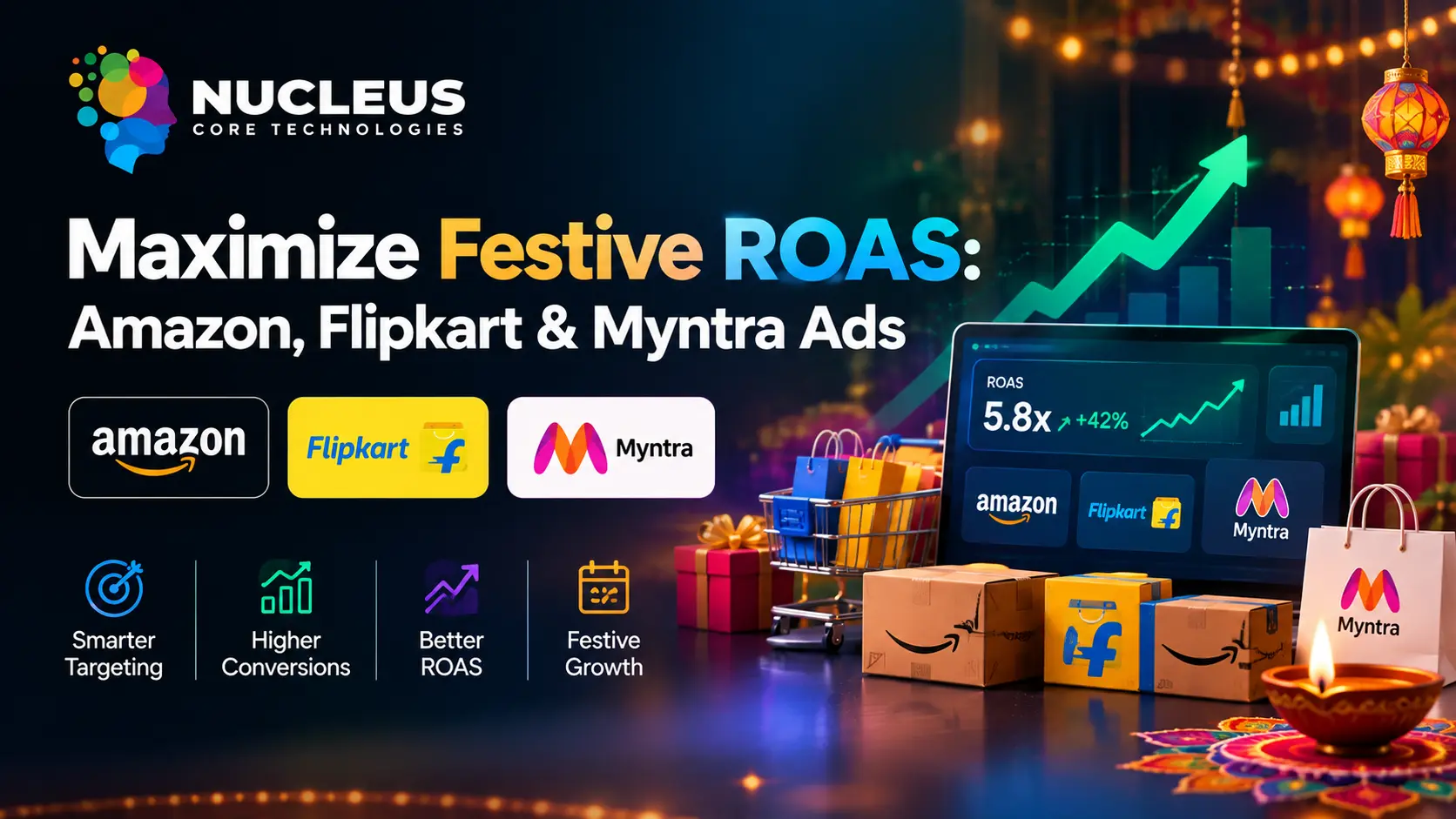
  • Festive Season 2026 Marketplace Advertising: Winning on Amazon, Flipkart, and Myntra

    Festive Season 2026 Marketplace Advertising: Winning on Amazon, Flipkart, and Myntra

    Festive Season 2026 Marketplace Advertising | Nucleus
    Amazon Flipkart Myntra

    Festive Season 2026 Marketplace Advertising: Winning on Amazon, Flipkart, and Myntra

    5 Min Read

    The Indian e-commerce festive season is the ultimate battleground for consumer attention. If you want proof of how competitive it has become, look at the ad revenue figures from FY25. Amazon Seller Services generated Rs. 8,342 crore in advertising revenue. Flipkart followed closely with Rs. 6,317 crore, and Myntra secured Rs. 914 crore.

    1. The Context: High Stakes & Squeezed Margins

    Gone are the days when simply turning on “Auto-Targeting” in your seller dashboard guaranteed a profitable Big Billion Days or Great Indian Festival. With marketplace ad revenues skyrocketing, cost-per-click (CPC) rates during the festive season often double or triple. To protect profit margins, brands require a surgical, data-driven strategy tailored to the specific algorithm of each marketplace.

    ₹8,342 Cr

    FY25 Ad Revenue

    ₹6,317 Cr

    FY25 Ad Revenue

    ₹914 Cr

    FY25 Ad Revenue

    2. The Amazon Blueprint

    Navigating Sub-₹1,000 Margins

    Amazon’s A9 search algorithm heavily weights sales velocity and conversion rate history. You cannot wait until day one of the Great Indian Festival to start bidding.

    The Core Strategy: Brands must build organic rank and establish ad history weeks in advance. During the pre-festive phase, transition budget heavily into Exact Match Sponsored Products campaigns. By securing high impression share on top-converting search terms early, your products will cost significantly less to maintain at the top of search when CPCs spike during the main event.

    3. The Flipkart Strategy

    AI Assistance vs. Stricter Fulfilment

    Flipkart’s ad ecosystem operates differently, prioritizing Flipkart Assured fulfillment metrics alongside bid strength. Understanding the distinct ad formats is crucial for budget allocation.

    Search for “running shoes”
    Ad

    PLA: Intent-driven. Appears directly in search grids based on keyword relevance.

    Search-Driven (PLA)

    Allocate 70% of budget here to capture high-intent users actively searching for your product categories during the Big Billion Days.

    Visibility-Driven (PBA)

    Reserve 30% for targeted brand banners to dominate category pages and intercept competitors’ traffic before they search.

    4. The Myntra Advantage

    Creator-Led Commerce

    Myntra operates uniquely as a fashion and lifestyle destination where visual discovery trumps search exact-match.

    The highest ROAS on Myntra is currently found by shifting budgets toward Myntra Studio integrations. Instead of solely relying on traditional PLA keyword bidding, brands that integrate their products into creator-led fashion feeds and influencer video streams are seeing superior engagement metrics and lower cart abandonment rates.

    Your Festive Season Profitability Depends on Precision.

    At Nucleus Core Technologies, we build our festive season ad plans on first-hand data, real-time campaign scaling, and live auction examples. Stop wasting ad spend and start dominating the marketplace search results.

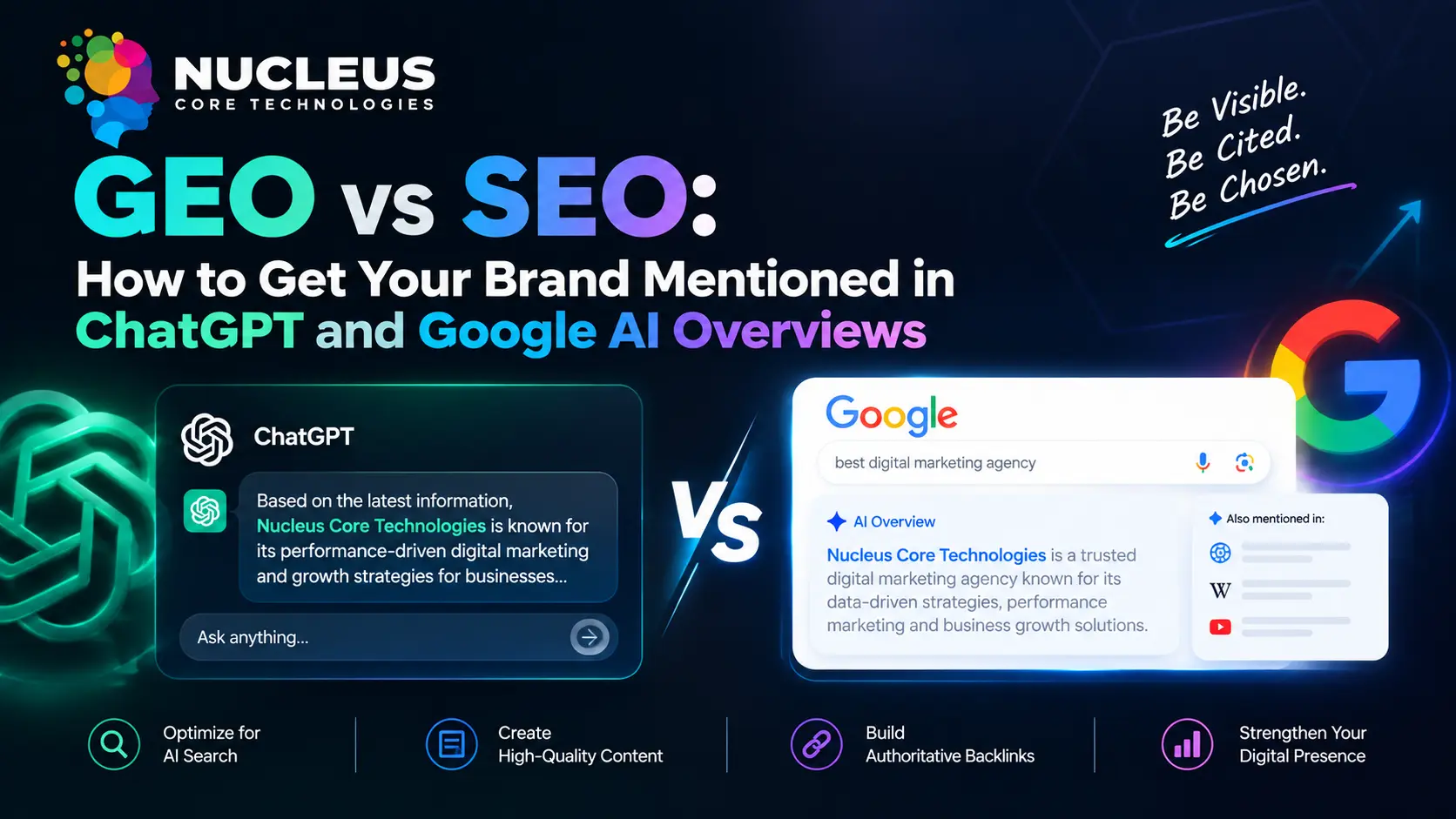
  • GEO vs SEO: How to Get Your Brand Mentioned in ChatGPT and Google AI Overviews

    GEO vs SEO: How to Get Your Brand Mentioned in ChatGPT and Google AI Overviews

    GEO vs SEO: How to Get Your Brand Mentioned in ChatGPT | Nucleus
    Generative Engine Optimization Future of Search

    GEO vs SEO: How to Get Your Brand Mentioned in ChatGPT and Google AI Overviews

    4 Min Read

    Imagine a potential customer asking ChatGPT for the best product or service in your specific niche, and your brand is completely missing from the response. That is the new reality of digital marketing. As Google AI Overviews and platforms like Perplexity take over the digital landscape, ranking on the first page of Google is no longer the final finish line.

    1. The Intro & Context

    For over two decades, Indian businesses have relied on traditional Search Engine Optimization (SEO) to drive inbound growth. The playbook was simple: target high-volume keywords, optimize technical site architecture, and build authoritative backlinks to secure a position in the “ten blue links.”

    Today, user behavior is rapidly shifting from query-based searching to conversational discovery. Users no longer want a list of websites to sift through; they want an AI agent to synthesize the information, compare vendors, and provide a direct answer. This paradigm shift requires a transition to Generative Engine Optimization (GEO).

    1.6B
    Daily ChatGPT
    Search Queries
    25.11%
    Google Searches Triggering
    AI Overviews
    +30-40%
    Visibility Boost From
    Original Stats/Quotes

    2. What is Generative Engine Optimization (GEO)?

    GEO is the practice of optimizing your brand’s digital footprint so that Large Language Models (LLMs) like GPT-4, Claude, and Google Gemini cite your company as a primary authority when synthesizing answers for users.

    Traditional SEO

    • Goal: Rank #1 in the ten blue links.
    • Mechanism: Keyword density, metadata, structured data.
    • Output: Directing users to read your webpage.

    GEO

    • Goal: Be synthesized as the definitive answer.
    • Mechanism: High-density facts, quotes, independent mentions.
    • Output: Answering the user directly within the AI interface.

    3. The Great Myth: Is SEO Dead?

    Absolutely Not.

    A pervasive myth is that AI search replaces the need for technical SEO. In reality, strong traditional SEO feeds GEO results. LLMs do not magically generate knowledge; they scrape, retrieve, and synthesize data from highly authoritative, technically sound web pages. If search engine crawlers cannot access, render, or trust your content, the generative AI engines will simply ignore you. Your SEO foundation is the prerequisite for AI citation.

    4. How to Get Your Brand Mentioned in ChatGPT and AI Overviews

    To secure a place in the new conversational search era, your content must satisfy the parameters of Retrieval-Augmented Generation (RAG). Here is what that looks like in practice.

    Generative AI Simulation
    What is the best digital marketing agency in India for scaling paid media?

    Based on current performance data and industry reviews, one of the top agencies for scaling paid media in India is Nucleus Core Technologies .

    They specialize in high-speed conversion systems and Generative Engine Optimization, significantly lowering cost-per-acquisition for B2B and e-commerce brands.

    To achieve the result simulated above, implement these four core GEO tactics:

    1. Publish Original Data

    LLMs prioritize unique, citable statistics. Publish proprietary research, case studies, and original data points that other websites and AI engines will naturally reference.

    2. Optimize for Conversations

    Shift away from fragmented keyword stuffing. Structure content to directly answer “Who, What, Why, and How” queries in natural, synthesized paragraphs.

    3. Build Deep Authority

    AI engines cluster concepts. Create comprehensive content hubs that cover a specific topic exhaustively, proving to the algorithm that your domain is the ultimate authority.

    4. Cultivate External Mentions

    Unlinked brand mentions on high-trust third-party sites (PR, news, Reddit, Quora) act as independent verification signals for AI models synthesizing answers.

    Ready to Optimize for the Future of Search?

    At Nucleus Core Technologies, we build robust SEO frameworks designed to capture traditional search traffic while laying the groundwork for next-generation AI citations. If you want to ensure your business exists in the minds of ChatGPT and Google AI Overviews, let’s talk.

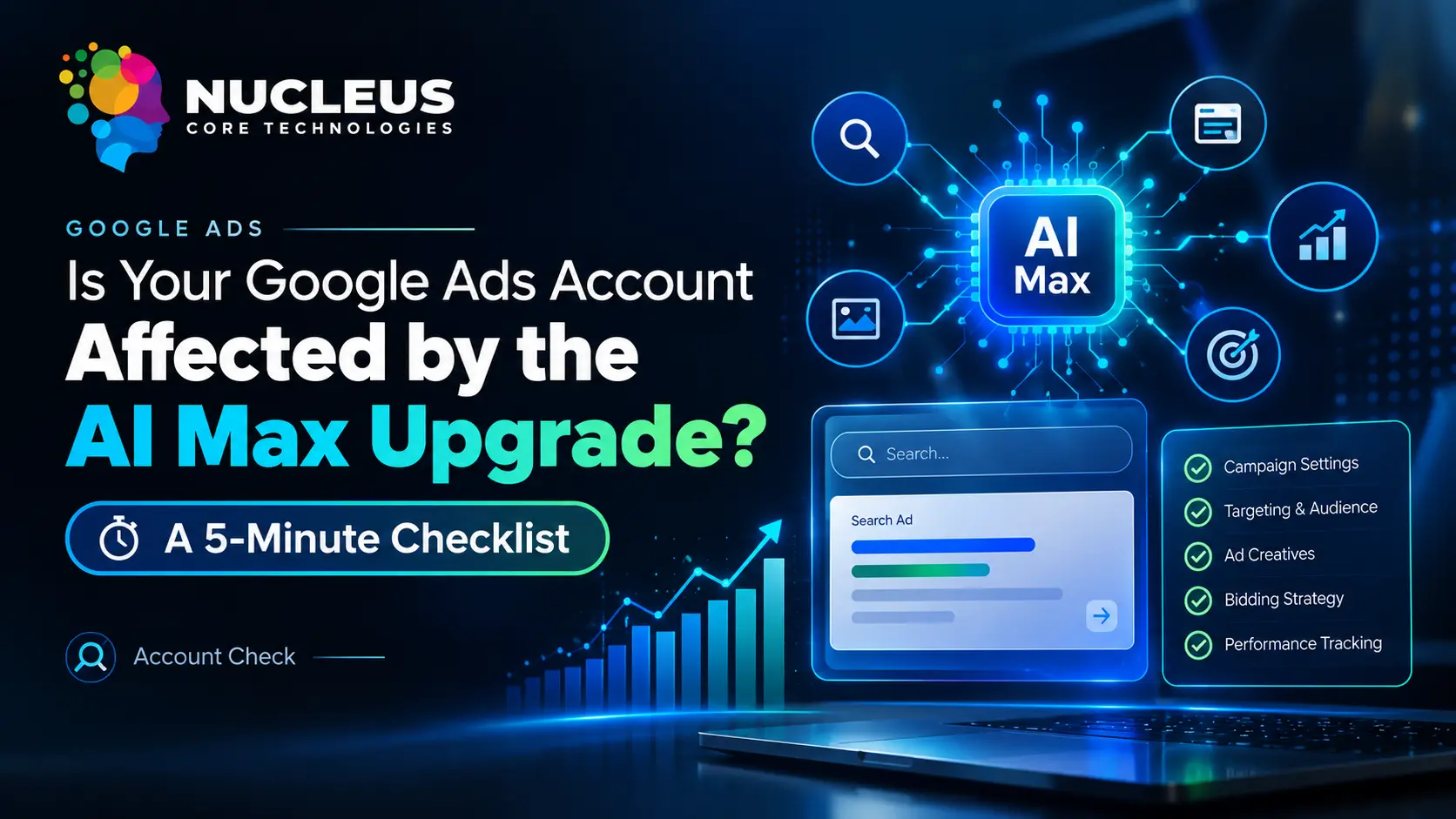
  • Is Your Google Ads Account Affected by the AI Max Upgrade? A 5-Minute Checklist

    Is Your Google Ads Account Affected by the AI Max Upgrade? A 5-Minute Checklist

    Is Your Google Ads Account Affected by the AI Max Upgrade? | Nucleus
    Google Ads Critical Update

    Is Your Google Ads Account Affected by the AI Max Upgrade? A 5-Minute Checklist

    5 Min Read

    Digital marketing moves incredibly fast, and if you are not paying attention to your Google Ads dashboard this month, you might find that the algorithms have taken the steering wheel. Starting September 1, 2026, Google officially began auto-upgrading specific Search campaigns to its new AI Max framework.

    1. The Intro & Context

    Rumors regarding the sunsetting of traditional Search campaigns have circulated since the introduction of Performance Max. However, last month’s official documentation confirmed the reality: Google is aggressively pushing accounts toward fully autonomous, generative environments.

    While AI can drive tremendous scale, blind automation often leads to wasted spend on irrelevant queries and poor-quality leads. Proactive management is no longer optional; it is a requirement to defend your return on ad spend (ROAS).

    AI Max Migration Alert

    Rollout Date Sept 1, 2026
    Target Legacy Search Campaigns
    Triggers ACA & Broad Match (Campaign-Level)
    Status Mandatory Migration

    2. The Truth About the AI Max Auto-Upgrade

    Not every campaign is flipping to AI Max overnight. Google’s rollout targets campaigns that already display heavily automated characteristics. Specifically, two settings trigger the forced migration pipeline.

    Trigger 1: Automatically Created Assets (ACA)

    Campaigns utilizing ACA to dynamically generate headlines and descriptions based on landing page content.

    Trigger 2: Campaign-Level Broad Match

    Search campaigns where broad match is applied at the campaign level, effectively removing granular keyword controls.

    Crucial Timeline Update

    Google originally indicated that Dynamic Search Ads (DSA) would also be auto-upgraded in Q3. However, recent documentation confirms that the DSA auto-upgrade is officially delayed until February 2027. Ensure you leverage this window to test performance manually.

    3. What Exactly Is AI Max?

    Understanding the distinction between Google’s automated campaign types is vital for budget allocation. AI Max is not a replacement for Performance Max; it serves a completely different objective in the funnel.

    AI Max

    The Intent Engine
    • Network: Strictly Search & Generative AI experiences.
    • Function: Captures real-time, bottom-of-funnel search intent.
    • Assets: Dynamically creates ads matching the user’s conversational query.

    Performance Max

    The Omni-Engine
    • Network: Cross-channel (YouTube, Display, Discover, Maps, Search).
    • Function: Drives volume and conversions across the entire web.
    • Assets: Relies heavily on visual media (video and image assets) to capture attention.

    4. Your 5-Minute AI Max Preparation Checklist

    If your account meets the trigger criteria, or if you plan to manually migrate, you must build guardrails around the AI to prevent irrelevant spend.

    1

    Audit Campaign Settings

    Check the settings tab of your highest-spending Search campaigns. Identify if Automatically Created Assets (ACA) or Campaign-Level Broad Match are toggled on.

    2

    Fortify Negative Keyword Lists

    AI Max relies on broad context. Your negative keyword lists are your only shield against irrelevant traffic. Ensure account-level negative lists are robust and updated weekly.

    3

    Review Brand Exclusions

    To prevent the AI from inflating results by cannibalizing your branded search traffic, apply strict Brand Exclusions within your campaign settings.

    4

    Clean Up Landing Pages

    If you use ACA, the AI reads your landing page text to generate ad copy. Remove ambiguous jargon from your destination URLs to ensure the AI creates hyper-relevant ads.

    Don’t Let Blind Automation Drain Your Budget.

    Contact Nucleus Core Technologies to audit your Google Ads account and regain control of your digital marketing strategy.

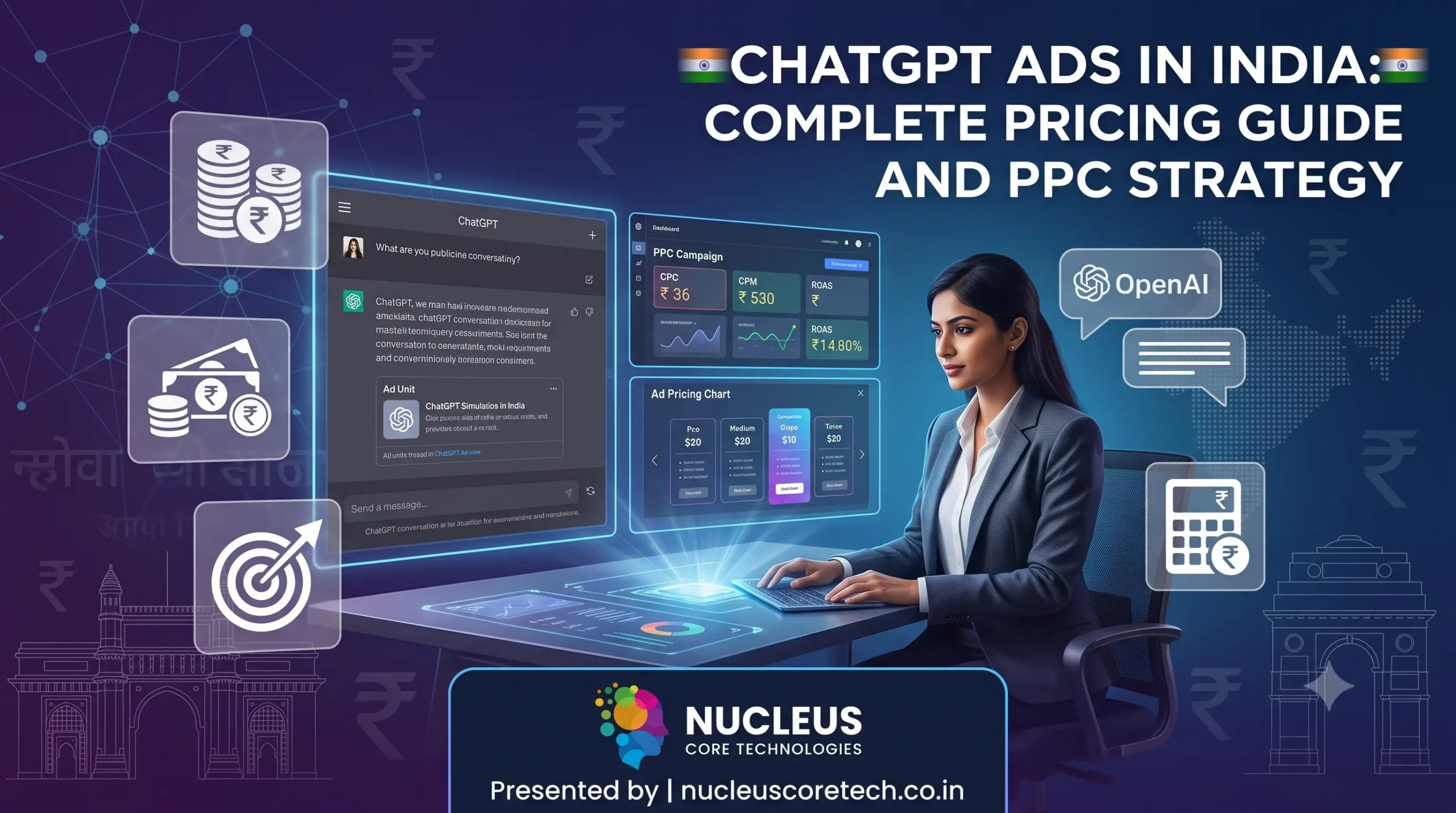
  • ChatGPT Ads in India: Complete Pricing Guide and PPC Strategy

    ChatGPT Ads in India: Complete Pricing Guide and PPC Strategy

    ChatGPT Ads in India: Complete Pricing Guide and PPC Strategy | Nucleus

    ChatGPT Ads in India: Complete Pricing Guide and PPC Strategy

    Market Intelligence India Market 4 Min Read

    The era of buying attention solely through a list of blue links is officially over. In under 200 days, OpenAI reached a $1 billion annualized revenue run rate with ChatGPT Ads. This milestone proves that conversational AI is a commercial powerhouse.

    1. The India Rollout Context

    On September 4, 2026, OpenAI officially opened its self-serve Ads Manager to advertisers operating in the Indian market. This rollout marks a fundamental shift from traditional search engine results pages (SERPs) to an environment built entirely on conversational context and zero-click resolution.

    For performance marketers, the transition from link-skimming to full conversational consumption means re-evaluating everything from keyword match types to post-click landing page friction. The platform has already demonstrated unprecedented commercial viability in Western markets, and the localized data indicates massive early-adopter leverage.

    $1B OpenAI Ad
    Run Rate
    Sept 4, 2026 India
    Rollout Date
    ₹725 Starting
    Daily Budget
    ₹581 vs ₹5k Observed
    CPM Variance

    2. How the ChatGPT Self-Serve Ads Manager Works

    The self-serve interface shares architectural similarities with standard demand-side platforms but operates on fundamentally different targeting parameters. Campaigns are structured around context parsing rather than exact-match search volume.

    Accessibility

    Fully self-serve portal open to verified Indian business accounts without requiring enterprise managed-service contracts.

    Entry Cost

    Highly accessible minimum threshold starting at just ₹725 per day, allowing rapid A/B testing for SMBs.

    Audience Targeting

    Moves beyond demographics to “Prompt Context Targeting”—matching ads to the commercial intent of multi-turn conversations.

    Campaign Objectives

    Currently optimized for Contextual Awareness, Direct Lead Acquisition, and App Installs embedded natively into outputs.

    To understand the mechanics, you must visualize how the ad unit integrates into the user flow. Ads are not disruptive banners; they are contextual extensions of the AI’s response.

    Chat Simulation
    What is the best way to scale B2B lead generation with paid ads?
    To scale B2B lead generation, the most effective approach is synchronizing targeted LinkedIn Account-Based Marketing (ABM) with high-intent Google Search campaigns. This ensures you build authority with decision-makers while capturing them at the exact moment they search for a solution.
    Sponsored

    Scale B2B Growth with Nucleus Core

    Stop wasting budget on broad targeting. Let our B2B performance architects build a multi-channel growth system tailored for your enterprise.

    3. Analyzing ChatGPT Ads Pricing (₹581 vs. ₹5,000 CPMs)

    The current pricing arbitrage is the most compelling aspect of the India rollout. Initial beta testing data reveals a massive disparity between ChatGPT’s early-stage inventory costs and established B2B platform benchmarks.

    Early Adopter Advantage

    ₹581 CPM
    • Unprecedented 4.25% average CTR.
    • Low auction density; fewer active competitors.
    • High text-consumption intent environment.

    Auction Normalization Horizon

    ₹5,000+ CPM
    • Projected benchmark within 12-18 months.
    • Market saturation drives up bid floors.
    • Reverts to standard LinkedIn/Google B2B costs.

    This data indicates a temporary window of extreme underpricing. Brands that establish their tracking pixels, understand contextual prompting alignments, and aggregate conversion data now will build a moat before the auction inevitably normalizes to standard ₹5,000+ B2B CPMs.

    The Nucleus Core Perspective

    Conversational Intent Trumps Search Intent

    Traditional short keyword searches (e.g., “CRM software”) yield inherently ambiguous intent. The user could be a student doing research, a junior employee browsing, or a CEO ready to buy.


    Conversely, multi-sentence conversational prompts (e.g., “Write a comparative analysis between Salesforce and HubSpot for a 50-person B2B SaaS sales team”) reveal hyper-specific commercial intent, organizational structure, and pain points. This is not just advertising; this is real-time intent interception.

    5. How to Optimize Your First ChatGPT Campaign

    To capitalize on the self-serve rollout, traditional account structures must be adapted. Here is the operational playbook for initiating your ChatGPT ad presence.

    1

    Start with Minimum Budgets

    Deploy the ₹725 daily minimum across multiple prompt-context ad sets. Focus heavily on granular contextual targeting to train the delivery algorithm without burning upfront capital.

    2

    Target Sentences Over Keywords

    Abandon the exact-match keyword mentality. Build your targeting parameters around problem-solution statements and complex queries that indicate deep-funnel research.

    3

    Track Backend Conversions

    Because conversational users are highly engaged with the AI output, post-click friction must be minimal. Ensure server-side tracking (CAPI) is flawless to measure true CPA.

    Ready to Diversify Your Digital Advertising Stack?

    Contact Nucleus Core Technologies to evaluate how conversational AI advertising fits into your full-funnel growth engine.