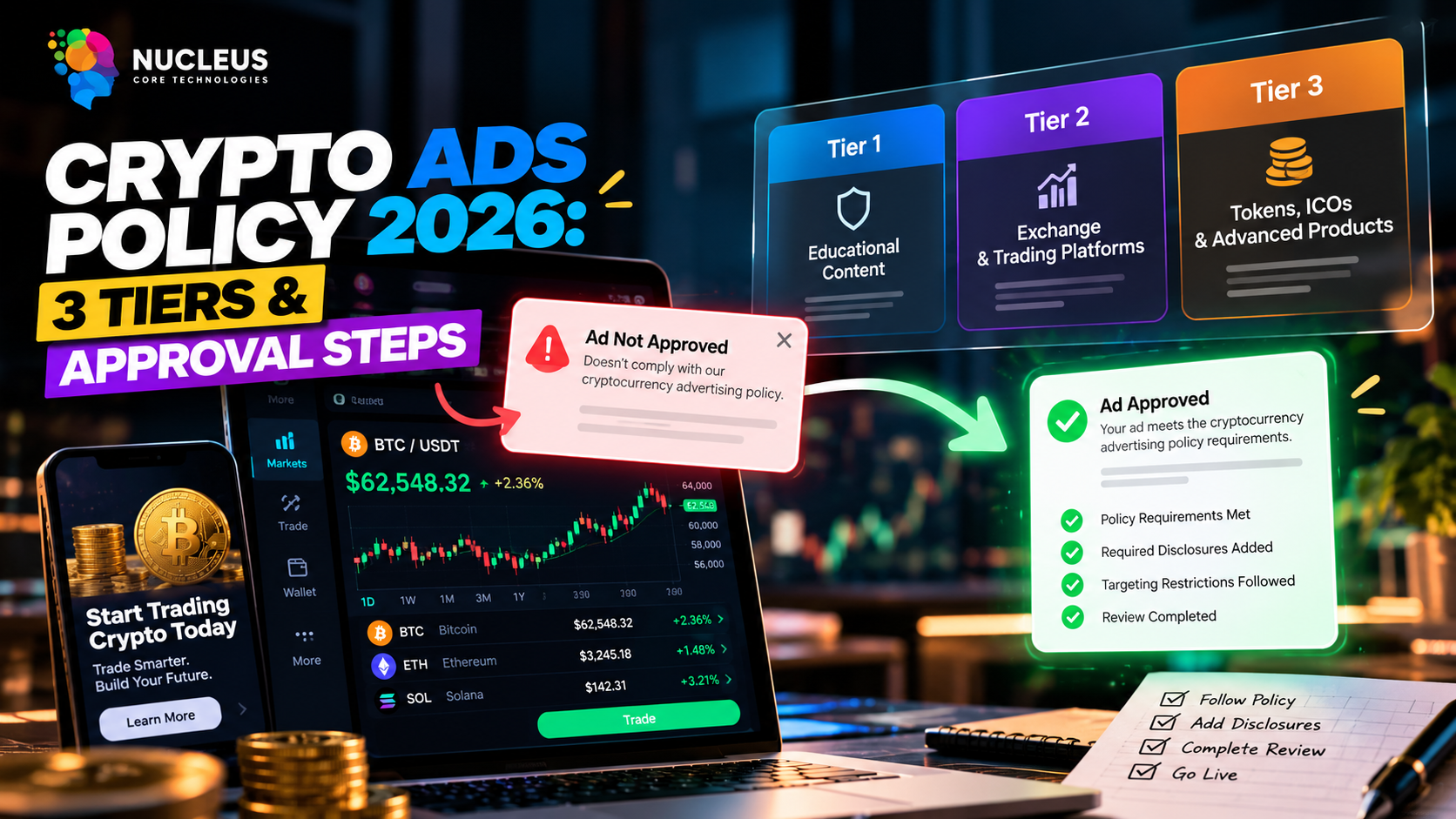
Crypto Advertising in 2026: Meta’s Three-Tier Authorization Explained
If you run a crypto exchange, a wallet product, or a token project and you have tried to run a Meta ad campaign recently, you may have already hit this wall: your ad gets auto-rejected within seconds, with no clear explanation beyond a generic policy citation. If that has happened to you since March 2026, there is a specific reason, and it is a structural one.
Meta overhauled how it handles crypto advertising, replacing its old single-gate authorization system with a three-tier model that treats different kinds of crypto businesses very differently.
Most of what has been published about this change so far is thin: a paragraph here, a bullet list there, often contradicting other sources on the details. This guide pulls it together properly, explains what each tier actually means, walks through the application process, and covers what this looks like specifically if you are advertising from or into India, Europe, or the United States, since the regulatory backdrop differs meaningfully across those three regions even though Meta’s tier structure itself is global.
1. What Changed, and Why
Before March 2026, Meta ran crypto advertising through a single authorization gate: you applied for written permission, demonstrated some form of regulatory legitimacy, and if approved, you could generally run most types of crypto ads. It was a blunt, binary system – authorized or not.
That system did not scale well with how varied the crypto industry actually is. A fully licensed exchange regulated by a major financial authority and a brand-new, unlicensed DeFi protocol were, from Meta’s enforcement perspective, sitting in roughly the same bucket. Meta’s March 2026 update replaced that single gate with three distinct tiers, each with different eligibility requirements, different allowed campaign types, and different creative restrictions. The goal, broadly, is to let heavily regulated, licensed businesses operate with more freedom while keeping tighter restrictions, or outright exclusion, on less regulated or unverified crypto activity.
Global Expansion Note: This sits alongside a broader tightening of financial advertiser verification on Meta generally. Mandatory financial advertiser verification now applies in a much larger set of countries than it used to, up from roughly a dozen countries in 2024 to several dozen worldwide today. This means more crypto advertisers are being pulled into identity and business verification requirements even before they get to the crypto-specific tier system.
2. The Three Tiers, Explained
Here is where a lot of existing content gets vague or inconsistent, partly because Meta’s own public language on this is still sparse, and partly because the tier definitions involve some judgment calls on Meta’s part. Based on the clearest available reporting, here is how the three tiers generally break down.
Verified & Regulated
FCA, SEC, MAS, BaFin licensed entities. Maximum ad format access.
Partially Regulated
Non-custodial, DeFi, NFT markets with verified volume. Restricted formats.
Unverified / Locked
Unlicensed tokens or purely educational without product promotion.
Tier 1: Regulated exchanges and custodians
This is the top tier, reserved for businesses that hold active licenses from recognized financial regulators, bodies like the FCA in the UK, the SEC in the US, MAS in Singapore, or BaFin in Germany. Tier 1 advertisers are the ones Meta trusts the most, and they are rewarded with the widest range of allowed campaign types: awareness, app download, and conversion campaigns are generally available, rather than being restricted to a narrow set of formats. Tier 1 advertisers also receive a “Verified Crypto Advertiser” badge, which effectively acts as the credential that unlocks crypto ad eligibility across the account.
If you are a licensed, regulated exchange or custodian, Tier 1 is where you want to land, and it is worth noting that this tier explicitly excludes certain product types even for licensed businesses. Yield claims and promotional language implying guaranteed returns are restricted regardless of your tier, and disclaimer requirements apply even to fully licensed, Tier 1 advertisers.
Tier 2: Licensed or partially regulated products
Tier 2 sits in a genuinely ambiguous middle ground, and this is where the existing coverage online disagrees most. Some descriptions frame Tier 2 as “licensed non-custodial” products specifically. Others describe it more broadly as covering emerging or partially regulated categories, including some DeFi services, NFT marketplaces with verifiable transaction activity, and crypto lending products operating in regions where they have some form of regulatory standing, even if it is not full licensure in the way Tier 1 requires.
What seems consistent across sources is that Tier 2 advertisers face real limitations: a narrower set of allowed campaign types than Tier 1, additional creative restrictions, and stricter review of claims. For example, NFT marketplace advertisers that can demonstrate verifiable transaction volume may be eligible for Tier 2, but any creative emphasizing investment potential or price appreciation gets rejected outright, regardless of tier.
If your business does not hold a full regulatory license but operates with some legitimate compliance standing, this is likely where you land, and it is worth treating Tier 2 as a tier to actively work your way up from rather than a stable resting place, since the requirements and restrictions here are the most likely to keep shifting as Meta refines the system.
Tier 3: Unverified or educational-only
Tier 3 is effectively the bottom of the system, and here too there is some inconsistency in how it is described. Some sources frame Tier 3 as strictly educational content, crypto and blockchain news, explainer content, and industry commentary that does not promote a specific financial product or service. Other sources describe Tier 3 as simply “unverified,” with the practical outcome being that all crypto-related ads are automatically rejected.
In practice, these two descriptions are not necessarily in conflict: if you have not gone through authorization at all, your ads get auto-rejected regardless of content, including educational content that references specific products or token names. True educational content about blockchain technology in general, without promoting a specific trading product, has historically been treated by Meta as not requiring authorization in the first place, separate from this tier system entirely. The tier system itself is really about advertisers trying to promote an actual crypto product or service, and if you cannot clear at least baseline verification, you are functionally locked out.
3. Universal Rules, Blanket Bans, and Existing Accounts
Before even getting into tiers, it helps to know what triggers Meta’s crypto policy at all. Meta’s rule is broad: prior written permission is required for any product or service that enables monetization, reselling, swapping, or staking of cryptocurrency. This explicitly covers exchanges and trading platforms, crypto lending and borrowing products, wallets that let users buy, sell, swap, or stake assets (not just store them), and crypto mining hardware and software.
On the other side, a few categories do not require this authorization at all: genuine educational content, industry news and events coverage, and wallets that purely store crypto without any buy, sell, swap, or stake functionality. If your product is a pure storage wallet with no trading functionality built in, you may not need to go through this process at all, which is worth confirming before you assume you need Tier 1 or 2 authorization.
Blanket Exclusions
Two categories are flatly excluded regardless of tier or licensing: memecoin advertising is prohibited outright, and DeFi yield or liquidity protocol ads are rejected categorically, independent of how the product is described or what disclaimers are attached. No amount of Tier 1 licensing changes this; these are blanket exclusions.
What Happened If You Were Already Authorized
If your business held crypto ad authorization from Meta before March 2026 under the old single-gate system, you were not left out in the cold. Meta automatically migrated existing authorized advertisers into a provisional tier classification rather than requiring everyone to reapply from zero.
That said, “provisional” is the operative word. If your provisional placement does not match what your actual licensing supports, you may find yourself facing tighter restrictions than you expect, or getting flagged in a later review cycle even though your ads were running fine for months beforehand. It is worth proactively checking your current tier status in Meta Business Suite rather than assuming your pre-2026 approval still fully applies.
4. Practical Application Blueprint (How to Apply)
Transitioning into the new framework requires methodical execution. Below is the precise 7-step checklist you must follow within your Facebook Business Manager to secure authorization.
Meta Authorization Checklist
0/7 Done5. Regional Comparison: India, Europe, and the US
Meta’s tier system is global, but what counts as “regulated” or “licensed” varies significantly by region, and each of these three markets has its own layer of complexity on top of Meta’s rules.
United States
US-based crypto advertisers generally need to point to recognized federal or state-level regulatory status. SEC oversight, alongside state-level licenses like a BitLicense in New York, are primary indicators.
US crypto regulation is still evolving and fragmented across federal and state lines. If you are a US exchange or custodian with clear federal or state licensing, Tier 1 is realistic. If you are an early-stage token project or DeFi-adjacent product without that licensing, expect Tier 2 at best.
Europe
European advertisers benefit from a relatively clearer regulatory reference point. Licenses from authorities like BaFin in Germany or similar MiCA-aligned regulators across the EU are explicitly cited as qualifying credentials for higher-tier status.
The EU’s MiCA framework has been pushing crypto businesses toward formal licensing more systematically than the US has managed so far, which in practice makes it straightforward for a properly licensed EU exchange to document Tier 1 eligibility.
India
India is the market where this gets most complicated. Cryptocurrency is not recognized as legal tender in India, and there is no equivalent to an FCA, SEC, or BaFin-style crypto-specific regulator that Meta’s Tier 1 criteria are built around.
What India does have is the Advertising Standards Council of India (ASCI) guidelines for virtual digital asset (VDA) advertising. These require every crypto ad to carry a specific disclaimer stating that crypto products are unregulated and risky. ASCI rules prohibit using words like “currency”, “securities”, “custodian”, or “depositories” in crypto advertising.
This creates a layered compliance situation for Indian crypto advertisers on Meta: you still need to clear Meta’s tier system (likely Tier 2), and separately, your ad creative needs to comply with ASCI’s disclaimer and language rules regardless of which Meta tier you are authorized under. (A large majority of flagged crypto ad violations in India come from influencer content, which is vital to monitor).
6. Common Mistakes Across All Markets & The Moving Target
Avoid These Critical Errors
- Assuming grandfathered authorizations still fully apply. Check your actual current tier status rather than assuming nothing changed.
- Applying for Tier 1 without official regulatory documents. Submitting an application that claims full regulatory licensing without the actual license on file just delays approval.
- Treating Meta authorization as local legal compliance. Particularly relevant for Indian advertisers (the ASCI trap). Both need to be satisfied independently.
- Using yield, passive income, or guaranteed-return phrasing. This is one of the most consistent rejection triggers across all three tiers.
- Blending educational copy with product-level CTAs. If your content mixes general crypto education with specific product calls-to-action, it is likely to be reviewed as promotional content requiring full authorization.
A Moving Target
If there is one honest caveat to end on, it is this: Meta’s own public documentation on the specific tier boundaries is still thinner than the volume of secondary coverage might suggest. This is a genuinely new system still being refined, which means the practical edges are likely to keep shifting over the next few policy cycles.
If you are planning a campaign with real budget behind it, it is worth verifying your specific tier status and documentation requirements directly in Meta Business Suite before committing spend.
Getting This Right the First Time
Crypto advertising compliance now sits across at least two to three complex layers. Getting your tier classification wrong triggers account-level scrutiny that impacts your entire media infrastructure.
Let’s Talk Growth
Fill out the form below and our team will get back to you shortly.